

Currently Empty: $0.00




Legendary Ways Academy · DevOps Services
DevOps Consulting Services for Teams That Need to Ship Faster
Senior DevOps engineers who plug into your existing team, audit what is slowing you down, and fix it, without the overhead of a full-time hire.
DevOps ConsultingCloud StrategyPlatform Engineering
If deployments still feel risky, your infrastructure is held together by tribal knowledge, or your team is spending more time firefighting than building, you do not necessarily need to hire five new engineers. Often what a growing engineering team needs first is DevOps consulting: an experienced outside team that has solved this exact problem before, brought in to diagnose the real bottleneck and fix it alongside your existing engineers instead of around them.
This page covers exactly what DevOps consulting services actually involve, who tends to benefit most from bringing in outside help, what a typical engagement looks like week to week, and how to think about consulting versus building an internal platform team. If you already know you want to talk to someone, skip straight to the bottom. If you are still evaluating whether this is the right move for your team, the sections below should answer most of what you are trying to figure out.
What We Do
DevOps consulting services cover the gap between “we know something is slow” and “here is exactly what to fix and how.” Our engineers audit your current pipelines, infrastructure, and workflows, then design and implement the changes that actually move the needle, from CI/CD pipelines to cloud cost, to on call reliability.
CI/CD Pipeline Optimization
Cut build and deploy times, remove flaky steps, and get your team shipping multiple times a day with confidence.
Infrastructure as Code Migration
Move manually managed infrastructure into version controlled Terraform, safely and incrementally, without downtime.
Cloud Cost Optimization
Identify oversized resources, idle infrastructure, and inefficient architecture that is quietly inflating your bill.
Reliability and Incident Response
Build monitoring, alerting, and on call practices that catch problems before your customers do.
Kubernetes and Container Strategy
Right size a Kubernetes setup for your actual scale, not a copy of what a much bigger company uses.
Security and Compliance Hardening
Close access control gaps, secure secrets management, and prepare infrastructure for SOC 2 or similar audits.
Who This Is For
DevOps consulting services tend to fit three kinds of teams particularly well. Fast growing startups whose infrastructure was built for ten users and is now creaking under ten thousand. Mid sized engineering teams that know they need DevOps expertise but are not ready to build a full platform team yet. And companies mid migration, moving from on premises to cloud, or from one cloud provider to another, who want an experienced hand guiding that transition instead of learning through expensive mistakes.
Startups in this position usually share a common story: the infrastructure that got them through their first hundred customers was built quickly, by whoever was available, without much thought for what happens at ten times the scale. That is not a criticism, it is just how early stage companies work. The problem shows up later, when every new feature takes longer to ship because the underlying systems were never designed to support the team’s current size.
Mid sized engineering teams, typically between fifteen and eighty engineers, often reach a different kind of ceiling. They have enough scale that manual processes are clearly breaking down, but not enough budget or headcount approval to build an internal platform team from scratch. Bringing in consulting expertise for a defined period lets them close that gap without a long term hiring commitment, and often builds the internal case for a platform team once leadership sees the results.
Companies in the middle of a cloud migration face a different risk entirely: getting the architecture wrong the first time and paying for it in both cost and downtime for years afterward. An experienced DevOps consulting partner who has run this exact migration before, on both AWS and Azure, is often the difference between a six week project and a six month one.
A good fit looks like this: your product team is blocked on infrastructure more than once a month, deployments require a specific person to be online, or your cloud bill grew faster than your traffic did.
DevOps Consulting Across Every Major Cloud
Cloud platforms share the same underlying DevOps principles, but the implementation details differ enough that platform specific experience genuinely matters. On AWS, we regularly work with ECS, EKS, Lambda, and the full suite of native CI/CD tooling alongside Terraform. On Azure, our engineers are comfortable across Azure DevOps pipelines, AKS, and Azure Resource Manager, useful for companies already standardized on Microsoft’s ecosystem. On Google Cloud, we work with GKE, Cloud Build, and Google’s IAM model, which differs meaningfully from both AWS and Azure in how it structures permissions.
If your infrastructure spans more than one provider, or you are actively deciding between them, that comparative experience tends to shorten the learning curve considerably compared to a consultant who has only ever worked in a single cloud ecosystem.
Common Infrastructure Problems We Fix
A few patterns show up in nearly every engagement, regardless of company size or industry.
- The “one person can deploy” bottleneck. Deployments depend on a specific engineer’s local setup or tribal knowledge, creating a single point of failure and a vacation blackout problem.
- Manually provisioned infrastructure. Servers and services were created by clicking through a cloud console, with no record of exactly what exists or why, making changes risky and audits painful.
- Slow, flaky CI/CD pipelines. Builds that take thirty or more minutes, or fail intermittently for reasons nobody has fully diagnosed, quietly cost hours of engineering time every week.
- Alert fatigue. Monitoring exists, but it fires so often for non issues that real incidents get missed in the noise, or nobody trusts the dashboards anymore.
- Runaway cloud spend. Resources get provisioned generously “to be safe” and never resized, and nobody has time to audit where the actual waste is.
- No disaster recovery plan. Nobody has actually tested what happens if a region goes down or a database gets corrupted, because building and testing that plan keeps getting deprioritized in favor of feature work.
Tools and Platforms We Work With
We are platform agnostic by design, since the right tool depends on your existing stack and team, not on what we personally prefer. Day to day, that most often means AWS, Azure, and Google Cloud for infrastructure, Terraform for Infrastructure as Code, Kubernetes and Docker for containers, and GitHub Actions, GitLab CI, or Jenkins for pipelines. On the observability side we regularly work with Prometheus, Grafana, Datadog, and the native monitoring tools of whichever cloud provider you are already using.
How We Measure Success
Vague reports about “improved reliability” are not useful to anyone, so every engagement starts by agreeing on a small set of measurable outcomes before any work begins. Depending on what brought you to us, that might be deployment frequency, mean time to recovery after an incident, build and pipeline duration, or monthly cloud spend against a defined budget. We check in against those numbers throughout the engagement, not just at the end, so there are no surprises about whether the work is actually paying off.
This matters because DevOps work can otherwise feel invisible to the rest of the business. A pipeline that used to take forty minutes now taking six is a concrete, defensible result you can point to when explaining the value of the engagement to leadership, and it is exactly the kind of number we make sure gets documented clearly.
How We Work With Your Existing Team
A consultant who never talks to your engineers and just delivers a report is not very useful. Our default working style is embedded and collaborative: joining your existing standups when relevant, working in the same project management tool your team already uses, and pairing directly with your engineers on implementation rather than handing off finished work with no context behind it.
We also intentionally avoid creating dependency on us. Documentation is written as we go, not reconstructed at the end, and we prioritize solutions your team can actually maintain after the engagement ends over clever solutions that only we understand. If a simpler, slightly less elegant approach is easier for your team to own long term, we will usually recommend that instead of the more sophisticated option.
Communication cadence is agreed upfront and adjusted as needed. Most embedded engagements include a weekly written update and a short review call, giving stakeholders visibility into progress without requiring daily check ins that eat into actual implementation time.
Getting Started
Every engagement starts the same way: a short call to understand what is actually going on, not a sales pitch. From there, most clients move into a paid infrastructure audit, which gives you a concrete, prioritized report even if you decide not to continue working with us. There is no long term contract required to get that initial clarity, and no pressure to commit to more than makes sense for where your team is right now.
If you are still deciding whether consulting is the right move versus building an internal team, that is a completely reasonable thing to talk through on the initial call as well. Part of our job is being honest about when a full time hire makes more sense than an ongoing consulting relationship, even if that means a shorter engagement for us. Our hire DevOps developers service exists for exactly that situation, when the right answer turns out to be adding permanent headcount rather than bringing in outside help.
Our Process
Every engagement follows the same four stage process, adapted to what we actually find once we look under the hood.
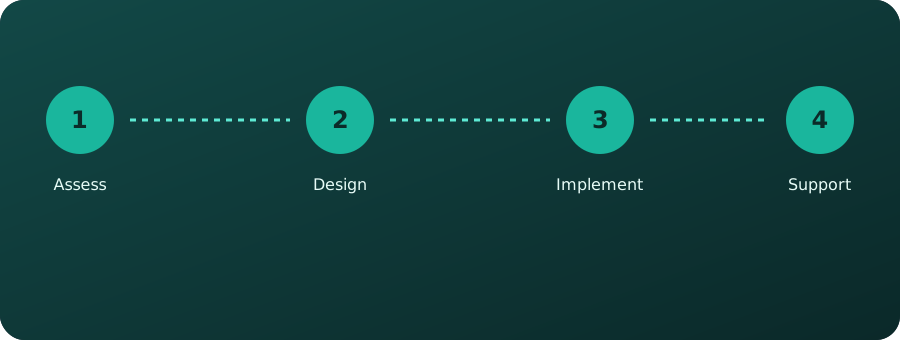
We start with a structured assessment of your current pipelines, infrastructure, and team workflows. From there we design a prioritized roadmap, focused on the changes with the highest impact first, not the longest list. Implementation happens incrementally and in the open, in your repos, reviewed by your team, so nothing becomes a black box you cannot maintain after we leave. Ongoing support is optional but available for teams who want a safety net while the new practices settle in.
Engagement Models
Most clients start with an audit, then choose one of the following depending on scope.
Infrastructure Audit
One time deep dive
- Full pipeline and infrastructure review
- Prioritized findings report
- Roadmap with cost estimates
Most Common
Embedded Engagement
Ongoing, part time or full time
- Senior engineer embedded in your team
- Hands on implementation work
- Weekly progress reviews
Project Based
Fixed scope, fixed timeline
- Defined deliverable, like a CI/CD rebuild
- Fixed price quote upfront
- Documentation and handoff included
Consulting vs. Hiring In House
Both paths are valid, and the right one depends on your timeline and budget.
| DevOps Consulting | Full Time Hire | |
|---|---|---|
| Time to start delivering value | 1 to 2 weeks | 2 to 4 months, including hiring |
| Access to senior expertise | Immediate | Depends on candidate pool and budget |
| Cost predictability | Fixed or scoped | Salary plus benefits plus recruiting cost |
| Best for | Specific problems or gaps | Long term, ongoing platform ownership |
Why Companies Choose Us
“They did not just fix our pipeline, they taught our team how to keep it fixed. Deployment time went from forty minutes to under six, and we have not had a rollback in three months.”
Engineering Lead, Series B SaaS company
Most consulting firms hand over a slide deck of recommendations and leave the implementation to you. We do the opposite. Our engineers write the Terraform, configure the pipelines, and open the pull requests, in your repositories, reviewed by your team, so the knowledge transfers as the work happens rather than in a handoff document nobody reads. That distinction is usually the biggest reason clients choose us over a traditional strategy consultancy.
We also keep engagements intentionally lean. There is no account manager layer between you and the engineer doing the work, no bloated team assigned to justify a bigger invoice. You work directly with the person solving your problem, which tends to mean faster decisions and fewer status meetings that exist only to produce more status meetings.
Frequently Asked Questions
How quickly can a DevOps consulting engagement start?
Most engagements begin within one to two weeks of the initial consultation, starting with the infrastructure audit so the roadmap is grounded in your actual environment.
Do you work with our existing tools, or require us to switch?
We work with your existing stack wherever reasonable. Recommendations to change tools only come up when the current tool is genuinely the bottleneck, not as a default suggestion.
Is DevOps consulting only for large companies?
No. Some of the highest impact engagements are with small teams of five to twenty engineers who cannot yet justify a dedicated platform hire but are feeling real pain.
What is the difference between DevOps consulting and DevOps development services?
Consulting focuses on strategy, audits, and guiding your team through changes. Our DevOps development services are more hands on, building and maintaining infrastructure and pipelines directly.
Can we start with a small project before a bigger engagement?
Yes, many clients start with a single project, like migrating to Infrastructure as Code, before deciding whether to continue with an embedded engagement.
How much does DevOps consulting typically cost?
Pricing depends on scope and engagement type. An infrastructure audit is a fixed, one time cost, while embedded engagements are typically billed weekly or monthly based on time commitment. We provide a specific quote after the initial consultation, not before.
Will your team have access to our production systems?
Only the access necessary for the agreed scope of work, granted through your own access control systems wherever possible, and revoked at the end of the engagement.
What industries do you typically work with?
Most of our clients are SaaS companies, fintech platforms, and e-commerce businesses, though the underlying DevOps problems tend to look similar across industries once you get past the surface details.
Advisory & Strategy Consulting, Personalized to Your Stack
Not every engagement needs a full audit. Some teams already know roughly where the problem is and want a devops advisory consultant to validate the approach, pressure-test a plan before it goes to leadership, or unblock one specific decision, like whether to consolidate CI/CD tooling or restructure a pipeline that has grown unmanageable. That is devops strategy consulting: shorter, more focused engagements built around a specific question rather than a full engagement.
A personalized devops consultation starts with a conversation about what you are actually trying to decide, not a generic checklist. If the question is CI/CD specific, for example choosing between GitHub Actions, Jenkins, and GitLab CI for a team that is scaling past what its current pipeline handles well, our ci cd devops consulting sessions focus narrowly on that decision: current pipeline behavior, where it breaks under load, and a concrete recommendation with a migration path, not a vague comparison.
We also work as an ongoing devops consulting service provider for corporations that need consistent DevOps advisory support across multiple teams rather than a single one-off project. Companies in this position have often already used devops consulting and managed cloud services from a large systems integrator and found the engagement generic and slow to produce anything concrete. Our model is the opposite: a small, senior team that stays engaged, knows your environment, and gives direct answers instead of a slide deck.
What Makes a DevOps Consultant Worth Hiring
A professional devops consulting engagement should leave you with something you can act on the same week, not a 40-page report that sits unread. Before hiring any devops consultant, ask what they will actually deliver, whether that is a prioritized fix list, a working pipeline change, or a documented decision with reasoning, and hold them to producing it early in the engagement rather than at the very end.
Related Resources
Ready to fix what is actually slowing you down?
Book a free consultation and get a prioritized breakdown of where your infrastructure and pipelines are costing you the most time and money.
Book a Free Consultation