

Currently Empty: $0.00




Legendary Ways Academy · DevOps Services
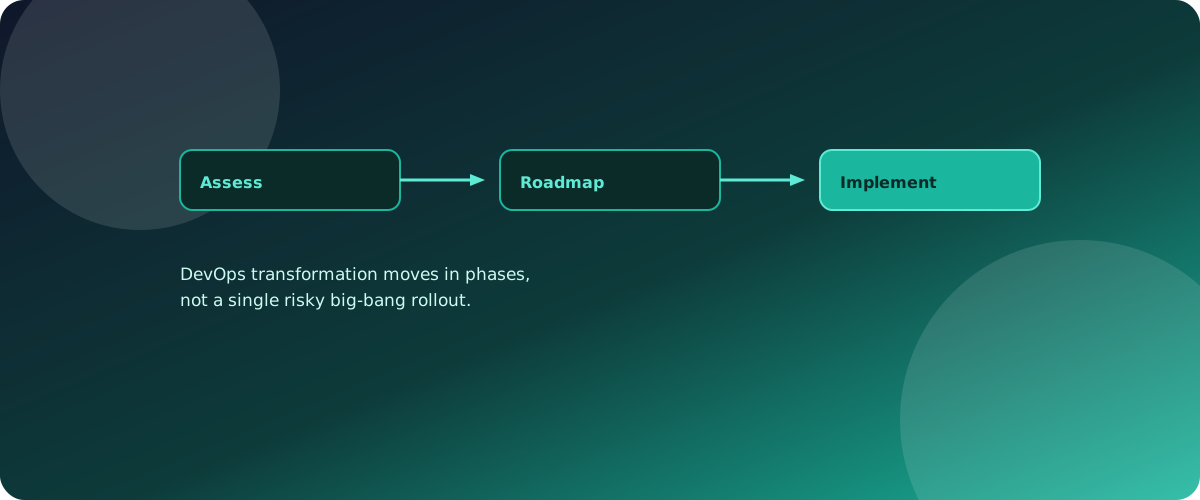
Move to real DevOps without a risky big-bang rollout.
DevOps transformation consulting for teams stuck between manual releases and the operating model they actually need: assessment, roadmap, and hands-on implementation, in that order.
Phased, not all-at-once
DORA metrics tracked
Enterprise-ready
What DevOps Transformation Actually Means
Digital transformation devops initiatives fail more often from unclear ownership than from bad tooling. A devops transformation service should not start with a tool recommendation, it should start by mapping how code actually moves through your organization today: who approves what, where releases get stuck, and which teams are working around broken processes instead of fixing them. That map becomes the basis for a devops transformation roadmap that sequences changes in an order that reduces risk instead of introducing it everywhere at once.
Enterprise devops transformation carries extra weight because change ripples across more teams, more compliance requirements, and more legacy systems that cannot simply be replaced. A devops transformation company working at that scale needs a devops transformation plan that accounts for teams moving at different speeds, some ready to adopt continuous deployment immediately, others needing months of groundwork first, without forcing every team through an identical playbook that fits none of them well.
A devops transformation consultant earns their fee by being honest about sequencing. The instinct in most organizations is to fix everything visible at once, new pipelines, new monitoring, new incident process, all in the same quarter. That approach almost always backfires: teams get overwhelmed, nothing gets fully adopted, and the initiative gets blamed for the resulting chaos rather than the all-at-once rollout that actually caused it. A devops transformation consultant’s real job is picking the one or two changes that unblock the most pain right now, proving they work, and using that proof to build support for the next phase.
Where Most Transformation Roadmaps Go Wrong
The most common mistake in a devops transformation roadmap is treating it as a technology migration project rather than an operating model change. Moving from Jenkins to GitHub Actions is a technology migration. Moving from “one person manually deploys on Friday afternoons” to “any engineer can safely deploy their own change at any time” is a transformation, and it requires new ownership boundaries, new testing discipline, and new trust between teams, not just new YAML files. A devops transformation strategy that only lists tools to adopt, without addressing who is accountable for what once those tools are live, tends to stall six months in when the initial enthusiasm fades and old habits creep back.
We have seen this pattern repeatedly: a company invests in a new CI/CD platform, runs a few pilot projects successfully, and then watches adoption plateau at 30 or 40 percent of teams. The tooling was never the constraint. The constraint was that nobody had actually decided who owns pipeline failures, who approves production changes outside business hours, or what happens when an automated deployment breaks something a human would have caught. Those are organizational questions, and no platform migration answers them by itself.
Signs You Need Transformation Consulting, Not Just a Tooling Fix
Releases are still scary
Every deploy needs a war room, off-hours timing, and someone on standby to roll back.
Teams work around the process
Engineers quietly bypass CI/CD gates or ship changes manually because the official path is too slow.
No one owns the pipeline
When a build breaks, it takes hours to find out whose job it is to fix it.
Our DevOps Transformation Journey, Phase by Phase
Weeks 1-2
Assessment
We map your current pipelines, deployment cadence, incident history, and team structure to find where transformation will actually move the needle first. This includes interviews with engineers actually doing the work, not just reviewing documentation that may no longer reflect reality.
Weeks 3-4
Strategy & Roadmap
A prioritized devops transformation strategy: which teams go first, what tooling changes, and how success gets measured at each phase. We present this roadmap to stakeholders before any implementation begins, so there is agreement on sequencing before work starts.
Months 2-4
Implementation
Hands-on work rebuilding pipelines, introducing Infrastructure as Code, and establishing the devops transformation team’s new working agreements. We stay embedded with your engineers during this phase rather than handing off a document and leaving.
Ongoing
Embed & Sustain
Documentation, training, and a handoff plan so the new operating model survives without us in the room. We also schedule a follow-up review at 90 days to confirm the changes stuck rather than reverting once the engagement ends.
Change Management Is Half the Work
Devops and change management get treated as separate disciplines more often than they should be. New pipelines and new tools do not adopt themselves, people have to change how they work, and that requires the same discipline as change management in devops circles has always demanded: clear communication about why the change is happening, training before the cutover, and a rollback plan for the process itself, not just the code.
Agile and devops transformation efforts tend to succeed together or fail together, because both are ultimately about shortening feedback loops. Devops in digital transformation initiatives that only touch technology and skip process and culture tend to stall within a year, the pipeline gets built but nobody trusts it enough to actually rely on it. Devops business transformation and devops cloud transformation work best when they are treated as one initiative with two workstreams, not two separate projects competing for the same teams’ attention.
In practice: the teams that succeed at transformation are the ones that treat the first pilot project as a proof point they can point to later, not a one-off exception. A successful pilot with real, measured results is the single best tool for getting the next team on board.
Measuring Whether the Transformation Is Actually Working
A devops transformation team needs a small set of numbers everyone agrees on before the work starts, otherwise “is this working” becomes a matter of opinion six months in. We track deployment frequency (how often code safely reaches production), lead time for changes (from commit to live), change failure rate (how often a deploy causes an incident), and mean time to recovery (how fast the team gets back to normal when something breaks). These four numbers, borrowed from the DORA research on high-performing teams, tell you more about transformation progress than almost any qualitative survey.
What we do not recommend measuring: raw tool adoption counts, like “80% of teams are now using the new CI/CD platform.” A team can technically use a new tool while still working exactly the way it did before, manual approvals, infrequent releases, no real automation. The DORA-style metrics above are harder to game because they measure outcomes, not adoption, which is exactly why they are worth the extra effort to track properly.
What a Realistic Engagement Looks Like
Most transformation engagements we run last three to nine months depending on organization size, though the first visible wins typically show up within the first month, a pilot team demonstrating faster, safer releases. That early win matters more than people expect, it is what turns a transformation initiative from something imposed on teams into something teams start asking for once they see a peer group moving faster with less stress.
Budget expectations vary widely based on scope, a single-team pilot engagement looks very different from a multi-year enterprise-wide rollout spanning dozens of teams. What stays consistent across every engagement size is the sequencing: assess first, build a roadmap grounded in what assessment actually found, then implement in phases with a measurable checkpoint after each one. Skipping straight to implementation without a real assessment is the single fastest way to spend a transformation budget without producing the operating model change it was meant to fund.
Common Transformation Pitfalls We Help Teams Avoid
Beyond the sequencing mistakes already covered, a handful of specific pitfalls show up again and again across transformation engagements, regardless of company size or industry.
Treating the Roadmap as Fixed Once Written
A transformation roadmap is a starting hypothesis, not a contract. Teams that treat the initial roadmap as unchangeable end up forcing a plan onto circumstances that have shifted, a reorg, a new compliance requirement, a team that turns out to be much further behind than assessment suggested. We build in a checkpoint after each phase specifically to revise the plan based on what the previous phase actually revealed, rather than pushing forward with an outdated assumption.
Skipping the “Why” With Engineers Doing the Work
Transformation initiatives announced from leadership without engineers understanding the reasoning behind specific changes create quiet resistance that shows up as slow adoption, not open pushback. Every phase of our engagements includes direct conversations with the engineers who will actually live with the new process day to day, both to gather their input on what will and will not work, and to make sure they understand why a given change is happening before it lands on their desk.
Underinvesting in the First Pilot Team
Because the first pilot becomes the proof point for every subsequent team, under-resourcing it is a false economy. Companies that assign their busiest, most stretched team as the pilot, reasoning that they will benefit most from automation, often see the pilot struggle simply because that team never had the bandwidth to properly adopt anything new. We generally recommend starting with a team that has some slack to invest in the transition, even if they are not the team under the most delivery pressure, since a strong first result matters more than starting with the highest-pressure team.
Confusing Activity With Progress
Migrating to a new CI/CD platform, writing new documentation, and running training sessions all feel like progress, but none of them are the actual goal. The goal is measurably faster, safer software delivery, tracked through the DORA metrics covered earlier. We check in against those numbers at each phase specifically to avoid the trap of declaring a transformation successful because a lot of visible activity happened, when the metrics that actually matter have not moved.
Frequently Asked Questions
How long does a DevOps transformation take?
Meaningful change in the first team typically shows up in 60 to 90 days. Rolling that model across a larger organization usually takes 6 to 18 months depending on team count and legacy system complexity.
Do we need to replace our existing tools?
Not always. Many transformations succeed by fixing how existing tools are used and connected before introducing new ones. We only recommend a tooling change when the current tool is genuinely the constraint.
Can this work alongside an ongoing Agile transformation?
Yes, and it usually should. Agile and DevOps transformation reinforce each other when run together rather than sequenced as separate initiatives.
What happens if a pilot team’s results are disappointing?
We treat this as diagnostic information, not failure. A disappointing pilot usually reveals a constraint we did not fully understand during assessment, and we adjust the roadmap accordingly before scaling further.
How do you choose which team goes first?
We look for a team with genuine appetite for change and enough slack to actually invest in the transition, rather than defaulting to whichever team is under the most delivery pressure or most vocally requesting help.
Do you work with fully remote or distributed teams?
Yes. Assessment interviews and roadmap workshops run just as effectively over video as in person, and most of our engagements already involve teams spread across multiple time zones.
Related Resources
Ready to build your transformation roadmap?
We start with an honest assessment of where your pipeline actually breaks down, not a generic playbook.
Book a Transformation Assessment